Faculty

Woxsen University – 3rd International Conference on Artificial Intelligence and Knowledge Processing | AIKP’23 | Call for Papers

Conference Details:

School of Business and AI Research Centre, Woxsen University, Hyderabad, India in collaboration with the University of St. Thomas, MN, USA is organizing the 3rd International Conference on Artificial Intelligence and Knowledge Processing – AIKP’23 (Scopus Indexed Conference) from 6th to 8th October 2023.

Aim & Scope of the Conference:

Artificial Intelligence & Knowledge Processing is playing a vital role in changing most of the sectors’ processes and landscape. AI has an enormous impact on various automation industries and their functioning converting traditional industries to AI-based factories. New algorithms are changing the way business processes and results are analyzed and predicted. Knowledge processing is the act of comprehending and then representing human knowledge in data structures; semantic models, which are conceptual diagrams of data as they relate to the real world; and heuristics, which are principles that lead to answers to every AI challenge. The way how a human think, knowledge processing transforms the data into knowledge and makes the machine think like a human and makes better decisions. This makes the humans work simple, but it has some ethical concerns that need to be sorted out. This AI and knowledge processing conference addresses the drawbacks and challenges in current practices in various sectors. The research area includes Artificial Intelligence, Deep Learning, Machine Learning, Decision Support Systems, Knowledge representation, semantics, Bigdata analytics, Intelligent systems, fuzzy-based neural networks, and other fields. 

Publications:

All accepted papers will be published in the proceedings with Springer in their Communications in Computer and Information Science Series (Scopus).

Important Dates:

Last date to submit the full paper: 5th  July 2023
Intimation of the acceptance of paper: 20th  July 2023

Last date to submit the revised paper: 20th  August 2023

Mode of Conduct:

Hybrid

GBSN for Business & Human Rights Exhibition | Conversations with the Next Generation

Background

The Rana Plaza factory located in Dhaka district (Bangladesh) collapsed on 24 April 2013. 1,134 people died and an estimated 2,500 people were injured. The collapse is considered to be the deadliest garment-factory accident in history. 

The Rana Plaza factory collapse led to worldwide outcry and pressure on fashion companies to change their business practices. As an immediate reaction to the disaster, apparel brands, retailers and workers unions signed a global framework agreement to improve occupational safety and health standards in the Bangladeshi garment industry: the Accord on Fire and Building Safety in Bangladesh, otherwise known as “the Accord”. 

The accident also played an important role in the field of business and human rights. In France, one of the countries related to the event through French apparel and retailer companies supply chain, the factory collapse accelerated efforts by lawmakers to adopt duty of vigilance legislation, passed in March 2017. Other legislations were adopted by local and national authorities in North America, Europe, and Asia-Pacific. The debate has since expanded at the global level and within regional authorities, the European Union currently working on a proposed mandatory human rights due diligence legislation: the Corporate Sustainability Due Diligence directive.

To reflect on the legacy of this dramatic event, GBSN is inviting our global community to engage and facilitate conversations in their local communities for wider dissemination. Conversations can take the form of event recordings, various forms of publications, illustrations, multimedia presentations, audio recordings, and more.

These conversations should be designed to include business school students, their lecturers and key business and human rights stakeholders including business professionals, policymakers, and civil society.

“Rana Plaza is an emblematic case study for the role of human rights in business.

Discussing root causes and the systemic human rights risks that resulted in the Rana Plaza tragedy is highly relevant for students that are training to become future business executives.

On the tenth anniversary of Rana Plaza, we want to learn from this tragic case in conversation with business school students. We need to build their capacity to transform business models so that human rights are at the core of all business operations.”

Dorothee Baumann-Pauly

Objectives of this activity

1

COMMEMORATE

Commemorate the 10-year anniversary of the Rana Plaza disaster and pay tribute to the victims of BHR violations

2

EMPOWER

Empower students interested in business and human rights to speak up about BHR issues

4

SHARE

Share examples of ongoing challenges, promising solutions and legislative action on BHR issues

5

INFORM

Inform the management education community and the broader public about the efforts of GBSN to advance business school education on BHR

How to Organize a “Conversation”

Conversations should be organized by one or several lecturers, ideally with the active participation of students. Several steps to a successful event:

  1. Identify a locally relevant business and human rights issue: challenges within a specific industry, business- or industry-wide solutions to address human rights risks, effectiveness or opportunity of legislation, etc. 
  2. Invite a speaker to discuss this issue with students and lecturers. Prepare the conversation with students so they can take an active role in the event.
  3. Organize and record the conversation, bearing in mind that the recording will be featured on a global platform. The duration of the recording should not exceed one hour.

For any assistance, reach out to Charles Autheman – charles.autheman@gmail.com.

University of Illinois | Assistant Course Manager / Course Manager / Senior Course Manager – Gies College of Business

Teaching and Learning

The Teaching and Learning team is a talented group of teaching, instructional design, and media professionals who are passionate about delivering educational excellence through innovation. We are dedicated to furthering the Gies College of Business’s mission of democratizing education. We revolutionize the delivery of a high-quality business education by harnessing technology to break through financial and geographic barriers.

We are accepting applications for Course Manager positions at three different job levels with varying requirements and responsibilities. Only one application is necessary. The level is determined based on qualified applicants’ backgrounds and qualifications.

The work location for this position may be flexible. Highly qualified candidates may be eligible to work full-time remotely within the US, on-premise at our offices in Champaign, Illinois, or a combination.

Assistant Course Manager Level:

The Assistant Course Manager is a member of a team that partners with Gies faculty to deliver and evaluate instruction. The team is responsible for planning and supporting teaching and learning for active courses within the Gies College of Business online educational portfolio. This role is responsible for assigned course preparation, delivery, and evaluation projects and collaborates with learning designers regarding course learning materials and infrastructure preparation. This role collaborates with Online Program Administration and other Teaching and Learning staff for course support infrastructure preparation for each term. The Assistant Course Manager collaborates with instructional and course support staff to address and evaluate course-related student and instructor concerns. This role helps coordinate the course debrief process, collect and analyze data, and organize course debrief conversations to identify opportunities for future course improvements that will enhance the student learning experience. The Assistant Course Manager participates in performance improvement projects.

Duties & Responsibilities

Teaching Support

• Execute master course plan and checklist from the pre-launch stage to debrief stage for all assigned courses

• Resolve support requests from faculty and staff as needed during course delivery for issues related to course management

The Assistant Course Manager is a member of a team that partners with Gies faculty to deliver and evaluate instruction. The team is responsible for planning and supporting teaching and learning for active courses within the Gies College of Business online educational portfolio. This role is responsible for assigned course preparation, delivery, and evaluation projects and collaborates with learning designers regarding course learning materials and infrastructure preparation. This role collaborates with Online Program Administration and other Teaching and Learning staff for course support infrastructure preparation for each term. The Assistant Course Manager collaborates with instructional and course support staff to address and evaluate course-related student and instructor concerns. This role helps coordinate the course debrief process, collect and analyze data, and organize course debrief conversations to identify opportunities for future course improvements that will enhance the student learning experience. The Assistant Course Manager participates in performance improvement projects.

Duties & Responsibilities

Teaching Support

• Execute master course plan and checklist from the pre-launch stage to debrief stage for all assigned courses

• Resolve support requests from faculty and staff as needed during course delivery for issues related to course management

Minimum Qualifications for Assistant Course Manager level:

Education: Required: Bachelor’s degree from an accredited institution in any field
Experience: Required: Experience with educational technology

Preferred Qualifications
Education: Preferred: Master’s degree from an accredited institution in business, organizational management, project management, educational technology, instructional design, education, or a closely related field

Experience: Preferred: Experience working in higher education; experience as an online instructor and/or student.

Knowledge, Skills and Abilities
Required: A successful candidate will have: • knowledge of compiling data and creating reports • organizational skills • ability to participate in a team • ability to participate in large, complex projects • ability to apply standards and follow documented procedures • ability to communicate and build relationships Preferred: • knowledge of Canvas LMS • knowledge of assessment and learning activity design • knowledge of pedagogy and learning science.

Course Manager Level:

The Course Manager is a member of a team that partners with Gies faculty to deliver and evaluate instruction. The team is responsible for planning and supporting teaching and learning for active courses within the Gies College of Business online educational portfolio. This role is responsible for managing course preparation, delivery, and evaluation projects; and coordinates with learning designers regarding course learning materials and infrastructure preparation and with Online Program Administration and other Teaching and Learning staff regarding course support infrastructure preparation for each term. The Course Manager collaborates with instructional and course support teams to address, evaluate, and mitigate course related student and instructor concerns. This role coordinates the course debrief process, collects and analyzes data, and organize course debrief conversations to identify opportunities for future course improvements that will enhance the student learning experience. The Course Manager mentors other course management staff and participates in performance improvement projects.

Duties & Responsibilities:

Teaching Support

  • Execute master course plan and checklist from the pre-launch stage to debrief stage for all assigned courses
  • Resolve support requests from faculty and staff as needed during course delivery for issues related to course management

Learning Support

  • Document observations during course delivery (including student feedback and issue resolution)
  • Annotate master course plan and launch checklist with observations
  • Compile data from multiple sources including course data dashboards and ticketing systems
  • Build debrief reports following defined templates incorporating data from the ticketing system for learner support and course management support issues

Project management and facilitation

  • Follow course delivery timelines and deadlines
  • Communicate all course debrief information to supervisor
  • Mentor other staff

Other

  • Participate in professional development
  • Other duties as assigned

Minimum Qualifications for Course Manager level: 

Education Required: Either (1) a Master’s degree from an accredited institution OR (2) a Bachelor’s degree from an accredited institution in any field with additional work experience noted below.

Experience Required: With a master’s degree, at least one year of work experience in online learning support OR with a bachelor’s degree, at least five years of work experience in online learning support by the time of hire.

Preferred Qualifications
Education Preferred: Master’s degree from an accredited institution in business, organizational management, project management, educational technology, instructional systems, education, or a closely related field.

Experience Preferred: Experience working in higher education; experience as an online instructor and/or student.

Knowledge, Skills and Abilities

Required: A successful candidate will have: • proficiency with educational technology • knowledge of compiling data and creating reports• organizational skills • ability to participate in a team • ability to participate in large, complex projects• ability to apply standards and follow documented procedures • ability to communicate and build relationships Preferred: • proficiency with Canvas LMS • knowledge of assessment and learning activity design • knowledge of pedagogy and learning science

Senior Course Manager Level:

The Senior Course Manager is a member of a team that partners with Gies faculty to deliver and evaluate instruction. The team is responsible for planning and supporting teaching and learning for active courses within the Gies College of Business online educational portfolio. The Senior Course Manager will collaborate with Online Program Administration and other Teaching and Learning staff to coordinate the course delivery and evaluation process and will be responsible for planning and management for course support projects in the Gies College of Business for online undergraduate, graduate, certificate, nondegree, and non-credit courses and programs as appropriate. The Senior Course Manager will collaborate with instructional and course support teams to evaluate and mitigate course-related student and instructor concerns. This role collaborates with other staff to identify course evaluation needs, and plan and manage the course debrief process to identify opportunities for future course improvements that will enhance the student learning experience. The Senior Course Manager will manage, train, and coordinate other course manager staff and plan and organize performance support and improvements.

Duties & Responsibilities:

Teaching Support

  • Schedule and assign courses to course managers each semester
  • Oversee, document, and manage intake and resolution of support requests for faculty and staff related to course management
  • Use data and reports to make recommendations based on educational best practices, instructional resources, and instructional technologies
  • Review course debrief reports and recommend needed changes and required level of work based on pedagogy and knowledge of instructional design.
  • Coordinate with Learning Design to implement quick fix and simple updates to courses or master course plans based on debrief reports

Learning Support

  • Plan and evaluate observations and reviews of student and faculty issues
  • Manage and maintain debrief report templates including data from the ticketing system for learner support and course management support issues

Project management and facilitation

  • Apply project management skills and best practices to oversee and ensure all courses follow course plans, checklists, and timelines
  • Plan course delivery timelines and effectively communicate expectations to stakeholders and direct reports
  • Apply project management best practices to coordinate course management workflows

Supervision and coordination

  • Supervise, mentor, train, and manage the performance of course managers and assistant course managers
  • Coordinate a team of course managers and assistant course managers
  • Plan course delivery timelines and allocate work to team members with the aim to meet deadlines and course schedules
  • Implement, track, and report on professional development direct reports
  • Plan communications and reports to the Director of Learning Support, Learning Design, and leadership

Training

  • Develop and maintain onboarding, train course managers, plan and schedule training on new technologies as needed
  • Support Teaching and Learning’s short and long-term strategies for training programs related to best practices in course delivery.

Other

  • Participate in professional development
  • Other duties as assigned.

 Minimum Qualifications for Senior Course Manager: 

 Education Required: A Master’s degree or higher from an accredited institution in business, organizational management, project management, educational technology, instructional design, education, or a closely related field.

Experience Required: At least one year of work experience supervising an online learning support team by the time of hire AND at least seven years of work experience in the field of online learning support at the time of hire.

Preferred Qualifications
Education Preferred: PhD from an accredited institution

Experience Preferred: At least four years of experience in an online learning support role; experience with mentoring and coaching staff to performance standards and professional development; experience with project management; experience evaluating and designing learning; management experience in higher education.

Knowledge, Skills and Abilities

Required: A successful candidate will have: • proficiency with educational technology • knowledge of compiling data and creating reports • organizational skills • ability to participate in a team • ability to participate in large, complex projects • ability to apply standards and follow documented procedures • ability to communicate and build relationships Preferred: • proficiency with Canvas LMS • knowledge of assessment and learning activity design • knowledge of pedagogy and learning science.

Appointment Information

This is a 100% full-time Academic Professional position, appointed on a 12-month basis. The expected start date is as soon as possible after 3/28/2023. Salary is commensurate with experience.

Application Procedures & Deadline Information

Applications must be received by 6:00 pm (CST) on March 28, 2023.

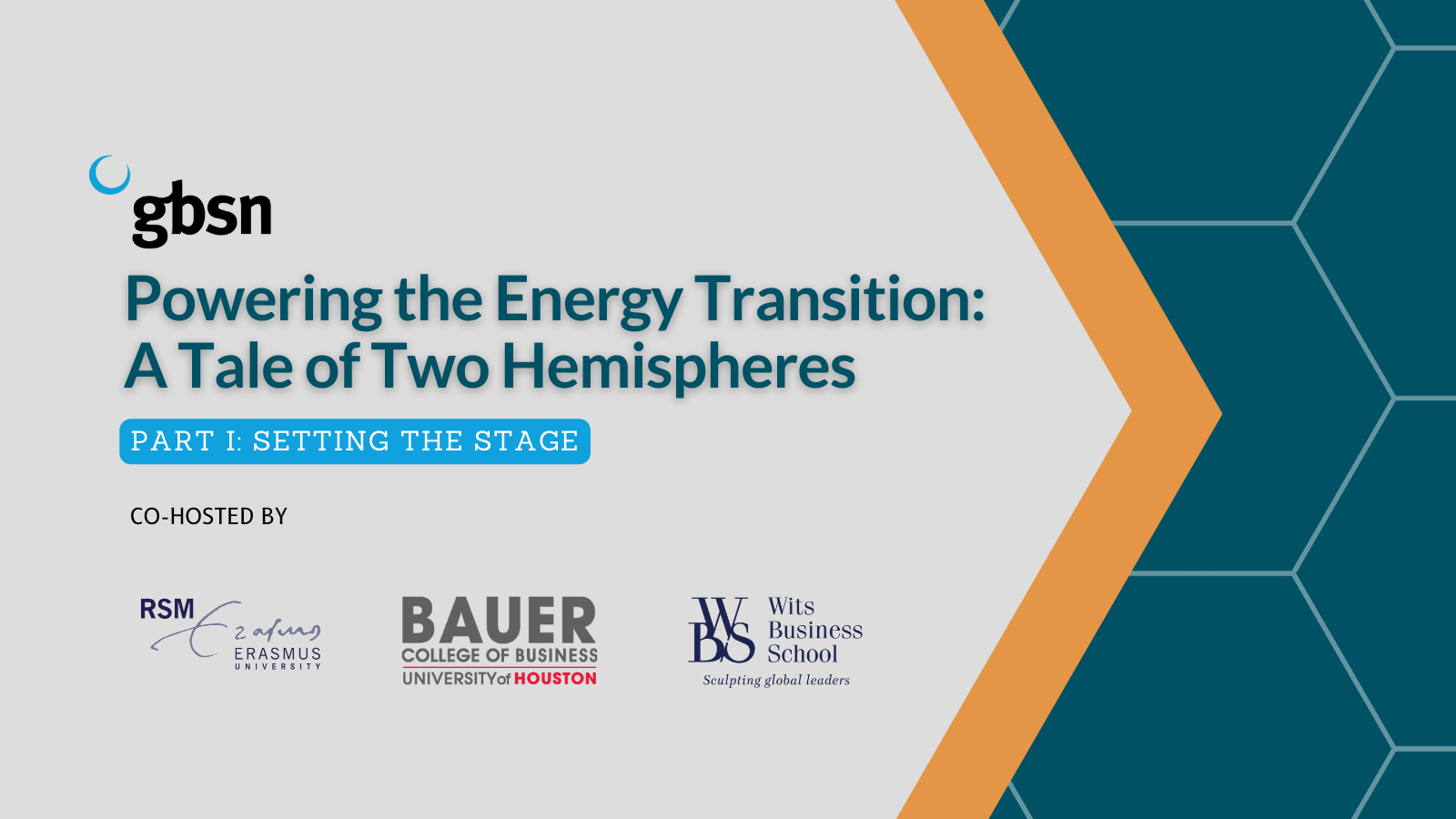
Powering the Energy Transition: A Tale of Two Hemispheres | Part 1: Setting the Stage


DATE & TIME

Tuesday 2 May

10:00 – 12:00 EDT/ 16:00 – 18:00 CEST

LOCATION

Hosted on Zoom.

CONTACT

Julie LaBelle, jlabelle@gbsn.org

QUICK LINKS

Series Home Page

GBSN for Energy Transition Impact Community


The global energy transition will involve the accelerated deployment of energy efficiency and renewable energy technologies. For the most, part big tech companies have committed to achieving zero emissions from their own activities. But it is their work in digitalization, artificial intelligence and information systems that could be potential game-changers in creating the smarter, more flexible energy systems needed to get to net-zero emissions. 

The GBSN for Energy Transition Impact Community is pleased to convene a five-part virtual series, Powering the Energy Transition: A Take of Two Hemispheres. The series will explore key elements of the energy transition journey through the global north and global south lens. Sessions will bridge attention to common goals with deep dives into critical nuances that differentiate the energy transition stories unfolding in different parts of the globe. 

Join us for Part I: Setting the Stage, on Tuesday, 2 May at 10:00am EDT/19:00 CEST, co-hosted by University of Houston, C.T. Bauer College of Business, Wits Business School, and Rotterdam School of Management, Erasmus University. Leaders from academia and industry will help to set the stage for our series looking at the energy transition journeys in the global north and south. We will explore the different energy transition paths through a north/south lens, and deep dive into areas in which those stories intertwine with common purpose and opportunities for shared learning and collaboration across a global network of business schools and their industry partners.

Date & Time

Tuesday 2 May

  • Singapore: 10:00PM
  • Beijing: 10:00PM
  • Sao Paolo: 11:00AM
  • Washington DC: 10:00AM
  • Lagos: 3:00PM
  • Cape Town: 5:00PM
  • Dubai: 7:00PM
  • Mumbai: 8:30PM

Co-Hosted By:

  • Bauer College of Business, University of Houston
  • Rotterdam School of Management, Erasmus University
  • Wits Business School, University of Witwatersrand
  • NJ Ayuk

    Executive Chairman
    African Energy Chamber
    Cameroon
  • Burhan Koç

    Executive Director of Business Development
    ENGIE North America
    USA
  • Dr. Ramanan Krishnamoorti

    Chief Energy Officer
    University of Houston
    USA
  • Lwazi Ngubevana

    Director
    African Energy Leadership Centre (AELC), the Wits Business School, University of the Witwatersrand
    South Africa

Registration

This virtual series welcomes all individuals interested in the topic. To secure your seat for the Part 1: Setting the Stage, please complete the registration form below.

Apply for Health Delegate Sudan position for Swiss Red Cross

Job Title: Health Delegate Sudan (100 %)

Location: Khartoum, Sudan with regular and prolonged travels to Northern and Kordofan States

Application Deadline: 19 February 2023

Position Start Date: 1 May 2023

  • The Swiss Red Cross (SRC) has been working with the Sudanese Red Crescent Society (SRCS) since 1999, supporting emergency interventions as well as longer-term development projects in different geographical and thematic areas. In 2023, SRC and SRCS are starting a new community-based intervention targeting communities in Northern State. The new project aims to prevent and combat non-communicable diseases (NCD), via awareness campaigns conducted by SRCS volunteers to promote healthy lifestyles and behavior change. For the upcoming project and its ongoing health projects in Kordofan, SRC is looking for Health Delegate (100 %) to be based in Khartoum, Sudan with regular and prolonged travels to Northern and Kordofan States.

Responsibilities

  • Support SRCS Health Department in its cooperation with international Stakeholders (WHO, INGO, Red Cross and Red Crescent Movement)
  • Support SRCS in elaborating its NCD strategy and enhance its capacity in NCD and behaviour change using IFRC toolkits
  • Support SRCS Branches in project implementation using PCM approach
  • Ensure financial management of the project in line with the SRCS and SRC policies
  • Provide technical support to SRCS and the Ministry of Health
  • Document and promote beneficial practices, knowledge management and institutional learning
  • Support SRC disaster management activities in case of emergencies in-country

Qualifications

  • Master’s in Public Health, International Health, Psychology, Education or alike
  • Expertise in development cooperation with specialization in community health with a focus on prevention
  • Minimum of 5 years of international working experience 
  • Proven capacities in project and team management including capacity-building and on-the-job training
  • International work experience with an INGO, preferably within the Red Cross and Red Crescent Movement
  • Demonstrated skills in financial management
  • Proven analytical and problem-solving skills with a proactive approach to finding and proposing solutions to challenges
  • Sense of diplomacy, flexibility and sensitivity to cultural differences and willingness to work in a challenging environment 
  • Experience with interventions in complex and fragile contexts
  • Very good command of written and spoken English, proficiency in Arabic is an asset

What you can expect

  • 12-months-contract with the option of extension, starting from 1st May 2023 or as per agreement.
  • Competitive salary, contribution to social insurances, R&R, travel expenses and contribution to accommodation

We look forward to receiving your complete application (motivation letter, CV, diplomas, employment certificates, reference letters), to the attention of Ms Gusuma Luder until 19 February 2023 latest.

Contact

Help us create a world  of greater humanity!

The Swiss Red Cross (SRC) is the largest humanitarian organization in Switzerland. We provide a broad range of services for the benefit of particularly vulnerable and disadvantaged people in Switzerland and in about 30 countries around the world. Our national headquarters in Bern and Wabern also support the SRC’s member organizations and institutions and provide the foundations for effective, efficient and sustainable services.

Faculty Development in International Business South Korea Program | Advancing Sustainability & Strategic Evolution in the Post-Pandemic Era

General Information

The Faculty Development in International Business (FDIB) South Korea program is a joint collaboration between Loyola Marymount University and Florida International University. The program is designed for educators interested in developing a greater understanding of doing business in Korea and exploring how Korean companies such as Samsung, Hyundai and LG have emerged as global competitors, advanced in sustainability, and strategically evolved post-pandemic.

Participants will gain firsthand experience about how South Korea has grown into a trillion-dollar-club economy that ranks the 10th largest in the world and has become a global innovation leader known as the “Miracle of the Han River.” Participants will visit top multinational companies, providing them with an opportunity to interact with executives and senior managers to discuss business in the region. In addition, participants will tour and visit historical sites for cultural experiences. Attendees will also listen to special lectures delivered by local scholars and network with other faculty to explore collaborative curriculum development and research interests.

A $4,000 program fee will cover hotel accommodations (based on single occupancy) with daily breakfast, ground transportation for activities, entry to cultural sites, business visits, and some meals. International airfare is not included.

Deadline to Apply

March 31, 2023

For questions, contact Marki Jones, Ed.D at Marki.Jones@lmu.edu or Jillian Avendano, M.S.Ed at javenda@fiu.edu.

Faculty Program Director: Yongsun Paik, Ph.D., Director, Center for International Business Education, Loyola Marymount University.

Position Announcement | André Hoffman Fellow: Data & AI Systems for Global Climate Modeling

The World Economic Forum and Columbia Business School seek a Hoffmann Fellow for a two-year joint appointment for work at the intersection of society, science, and technology. The Fellow will be based jointly at the World Economic Forum’s Center for the Fourth Industrial Revolution in San Francisco, California, which is dedicated to addressing the possibilities and challenges posed by the rapid pace of technological innovation in the Fourth Industrial Revolution, and Columbia Business School, a dynamic center of research, with faculty, postdoctoral, visiting scholars, and doctoral students taking a wide range of approaches to social science research with applied implications.

Hoffman Fellowship Program

The André Hoffmann Fellowship for the Fourth Industrial Revolution offers early-career academics the opportunity to work at the intersection of society, science and technology through a joint appointment between the World Economic Forum and leading academic institutions.

The two-year Hoffmann Fellowship term is co-hosted evenly between the World Economic Forum and a partnering academic institution. Fellows are expected to commit full-time to the role. With joint guidance
from a Forum project director and a faculty supervisor, the Fellow will help build and drive intensive collaborations among the Forum and academic institution partners to deliver specific action-oriented outcomes through:

  • Developing and executing initiatives to bring technology to bear on solving important global challenges
  • Engaging Forum Partners – including leaders from the private sector, governments, international organizations, civil society and faculty from diverse academic disciplines – to build selected initiatives
  • Researching key issues and the potential to harness Fourth Industrial Revolution innovations to provide solutions

About the Project

The intent of the project is to identify the best path forward to leverage climate projection information, especially leveraging artificial intelligence, for climate action at scale. Central to doing this work will be action-oriented deliverables, such as written best use-cases in which climate projections have been successfully leveraged to define climate adaptation strategies at regional, national, and sub-national level per defined end-user group.

The Fellow will spearhead a project aimed at addressing the barriers to scale hindering the effective use of climate model data for climate action. This could include: 1) Data compatibility and accessibility, working towards inclusive and accessible climate datasets. 2) Increasing inclusive access to climate projection data, especially for developing countries. 3) Strengthening domain expertise and management capabilities to turn insights from climate model projections into actionable policy making decisions. In particular, the project will focus on: (a) defining high impact application areas to leverage climate projection information for climate action and adaptation; (b) assessing potential end-user groups and their needs that accurate climate projections can address; and (c) addressing technical barriers to scale and accessibility in data, and for harnessing AI. The Fellow will report to the Head of Artificial Intelligence & Machine Learning at the World Economic Forum.

About the Research

The Fellow will also conduct state-of-the-art research related climate change and climate adaptation. This could include, but is not limited to, understanding public and private stakeholders’ responses, and adaptation, to climate projections and climate-related initiatives. The exact nature of this research could vary, as it will depend on the Fellow’s research area of focus and interests. The Fellow will report to and work with Vanessa Burbano, the Sidney Taurel Associate Professor of Management, at Columbia Business School and Director of Corporate Engagement for LEAP (Learning the Earth with Artificial Intelligence and Physics).

Preferred Requirements and Experience

The candidate will be assessed on their fit with both (1) the research aspect, and (2) the program aspect, of the Fellowship.

  • With respect to the fit with the research aspect:
    • Candidates for the Hoffmann Fellowship come from a diversity of disciplinary and social backgrounds. We are looking for a candidate who will have completed their PhD in a relevant discipline prior to beginning the Fellowship, including but not limited to Management, Strategy, Organizational Behaviour, Economics, Public Policy, Climate & Sustainability, Artificial Intelligence, etc.
    • Candidates will be assessed on the promise of their research program and the fit of their planned research program with the objectives of the fellowship.
  • The candidate will also be assessed on their fit with the project role; for example, on qualities such as:
    • Inter-personal skills;
    • Self-starter, with the ability to work independently and as a member of a team, and who can manage multiple projects simultaneously
    • Experience working in or collaborating with the public or private sectors;
    • Ability to work across different cultures and with high-level officials and executives, as the Forum shares its work with a global audience;
    • Command of spoken and written English; proficiency in other languages is an advantage;
    • Strong program and project management experience, with strong organizational skills; and
    • Understanding of the issue of leveraging data for climate modeling.
  • One key selection criterion is related to diversity and inclusion. We look for excellence, and at the same time, the program aims to open opportunities for candidates from underrepresented groups and institutions.

Key Responsibilities

The intent of the project is to identify the best path forward to leverage climate projection information, especially leveraging artificial intelligence, for climate action at scale. Central to doing this work will be action-oriented deliverables, such as written best use-cases in which climate projections have been successfully leveraged to define climate adaptation strategies at regional, national, and sub-national level per defined end-user group.
The initial outline for the project would be to:

  • Build on the initial work done between LEAP and the World Economic Forum to further define the collaboration.
  • Map and review current climate projection efforts and methodologies and assess application areas to drive climate action and adaptation.
  • Map and review end-users and associated needs that GMCs can address.
  • Develop novel approaches to address above mentioned barriers to scale and uptake.
  • Convene relevant stakeholders on the above points to derive input in how to address these challenges.
  • Provide recommendations for the use of GMCs to drive climate action through written products, e.g. governance frameworks, use cases, toolkits, best practices and agenda blogs.

About the World Economic Forum


The World Economic Forum, committed to improving the state of the world, is the International Organization for Public-Private Cooperation. The Forum engages the foremost political, business and other leaders of society to shape global, regional and industry agendas. The Forum hosts 18 platforms for advancing public-private cooperation on a range of global, regional and industry issues. The Centre for the Fourth Industrial Revolution is a hub for global, multi-stakeholder cooperation to develop policy frameworks and advance collaborations that accelerate the benefits of science and technology.

About Columbia Business School and LEAP

Columbia Business School is a dynamic center of research, with faculty, postdoctoral, visiting scholars, and doctoral students taking a wide range of approaches to social science research with applied implications. More information about Columbia Business School can be found here. LEAP is a National Science Foundation (NSF) Science and Technology Center (STC) which aims to revolutionize climate projections using Artificial Intelligence for informed targeted climate adaptation. Driven by a collaboration between Columbia University, Teacher’s College, NYU, University of California-Irvine, and University of Minnesota, LEAP’s mission is to increase the reliability, utility, and reach of climate projections through the integration of climate and data science. The Center is engaging with top climate research laboratories and major computing organizations to optimally utilize the wealth of data available for climate modeling to better predict the future. LEAP also strives to ensure that the broadest range of private and public stakeholders will have access to the tools necessary for informed decision-making on behalf of their communities in the face of climate change.

Duration and Location of the Fellowship

  • The André Hoffmann Fellowship is two years in duration and Fellows are asked to commit full time to their role.
  • The World Economic Forum and Columbia Business School are looking for a Hoffmann Fellow to contribute to both the project and research roles while jointly reporting to the Head of Artificial Intelligence & Machine Learning at the World Economic Forum and to the Sidney Taurel Associate Professor of Management at Columbia Business School.
  • The role will be based in New York at the Columbia Business School while jointly working with the World Economic Forum in Geneva, New York & San Francisco.
  • The Hoffmann Fellow will be working in collaboration with the Forum, the C4IR and Columbia University in New York. Primarily based in New York, depending on project needs, the Fellow will be expected to travel to the Forum’s Geneva or San Francisco office occasionally during the two years.

The World Economic Forum and Columbia Business School are equal opportunity employers.

To Apply

Send the following package to mgmtjobsearch@gsb.columbia.edu:

  • Curriculum Vitae
  • Personal statement addressing:
    • Your past academic research and future academic research plans;
    • Your relevant work experience and how your skills, expertise and networks can help drive this project forward;
    • Any involvement in broader impact activities relevant to the scope of the Hoffmann Fellowship (ocean science, policy, data, and technology);
    • Why you are interested in the Hoffmann Fellowship and how you envision it furthering your career.
  • Three (3) references, with at least two (2) references who can speak to your academic research potential and at least one (1) reference who can speak to your broader impact activities.

Term Period is 24 months. Applications will be reviewed on a rolling basis and should be submitted by February 28, 2023 in order to receive full consideration. We expect to make selection by April 29, 2023.

2023 Energy Innovation in LMICs Global Case Writing Competition

The William Davidson Institute at the University of Michigan cordially invites you to enter our competition and submit your business case study about an energy innovation by a profit-seeking business in one or more low- and middle-income countries (LMICs).

The world needs $1.3 trillion in incremental investment by 2030 in energy output and infrastructure, according to J.P. Morgan’s Annual Energy Outlook. Most of the new  demand will come from emerging markets as they continue to work toward their development goals. At present, nearly 733 million people in the world live with no electricity. By 2030, 670 million people still won’t have it. And, approximately 2.6 billion people cook or heat their homes with fossil fuels that pollute the environment and can be harmful to their health. According to the International Energy Agency, price and economic pressures due to the current global energy crisis mean that the number of people without access to modern energy is rising for the first time in a decade.

Innovation is needed to address the large-scale and complex challenges related to energy. The global transition away from fossil fuels toward renewables is creating new market opportunities, especially in LMICs. In addition to policy, technology and other solutions, developing and scaling profitable business models is a crucial aspect of meeting evolving energy needs in LMICs.

WDI is proud to offer a competition aimed at increasing the number of academic business cases available about this very important topic.

Please see our Submission Requirements for more information.

Who Can Enter?

  • Individual students or student teams (graduate or undergraduate) and other professionals may enter, but must enter in collaboration with a faculty member or instructor from an accredited university/college, in the U.S. or internationally.
  • Individual faculty/instructors or teams from an accredited university/college (in the U.S. or internationally) may also enter.

Key Dates

  • December 14, 2022 (10am-11am EST): Informational webinar. Register HERE.
  • January 31, 2023: “Intent to Enter” forms due.
  • March 31, 2023: Final submission documents due.
  • July 2023: Public announcement of winners.

Steps to Enter

  1. Review Submission Requirements, as well as Resources.
  2. Review Frequently Asked Questions.
  3. Submit online Intent-to-Enter Form by January 31, 2023.
  4. Submit online Submission Form and final documents by March 31, 2023.

Competition Objectives

  • Encourage and reward the development of new business case studies that focus on an energy innovation in one or more low- and middle-income countries.
  • Publish higher education case studies that will help develop the necessary critical thinking skills in today’s students regarding the unique energy characteristics of LMICs.
  • Accelerate global knowledge of energy innovations being implemented by businesses in LMICs.

Prizes

  • 1st Place Award: $3,000
  • 2nd Place Award: $2,000
  • 3rd Place Award: $1,000

WDI Publishing will formally publish and distribute the winning cases.

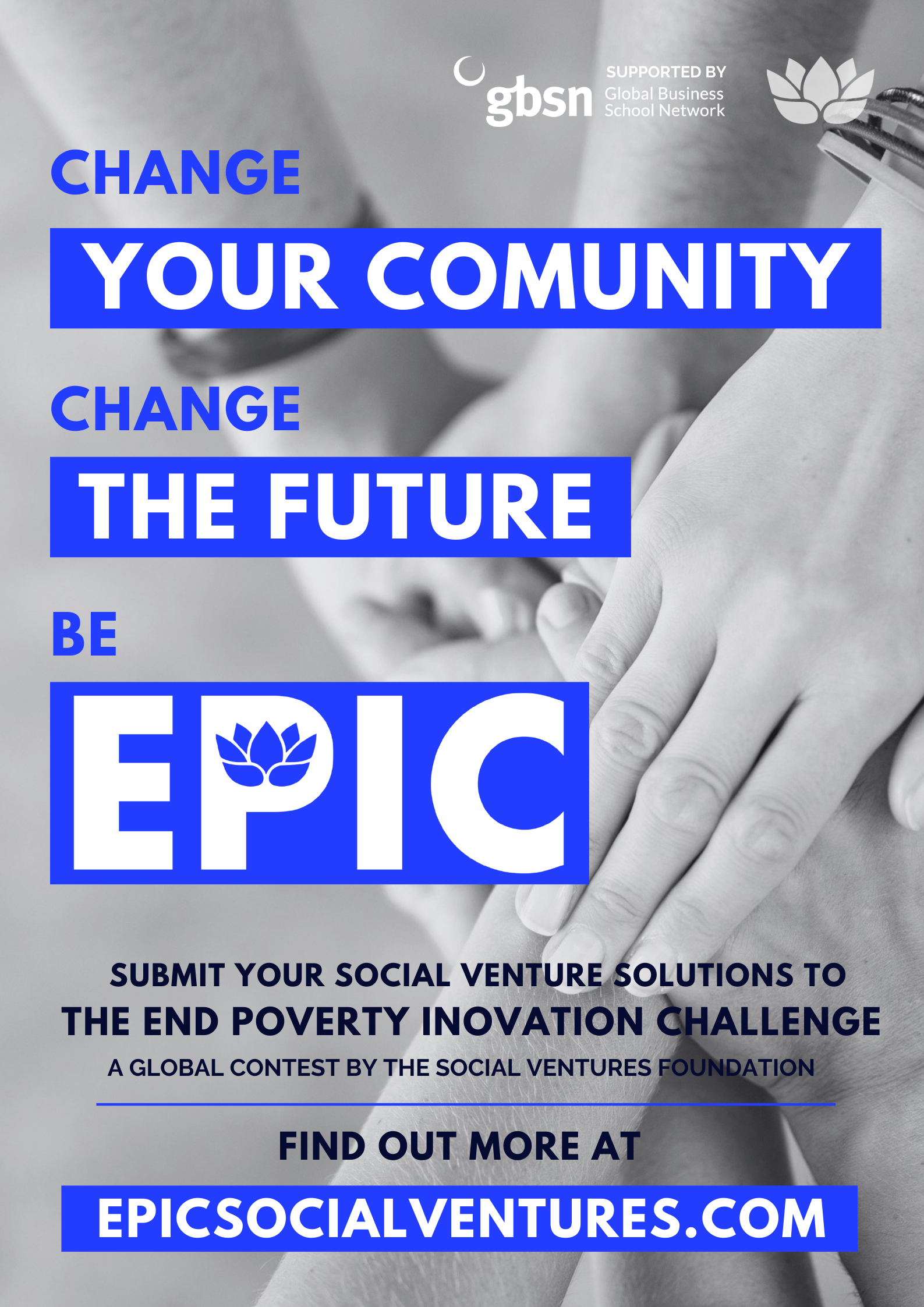
Submit an Application for the 2023 End Poverty Innovation Challenge (EPIC)

GBSN member school students are invited to apply to the 2023 EPIC, a global competition and pipeline for outstanding social ventures that provide sustainable grass roots solutions to local poverty reduction challenges.

EPIC, the End Poverty Innovation Challenge, is focused on engaging the next generation of social entrepreneurs from post secondary institutions worldwide in developing the next generation of social ventures that lift the livelihoods of the poor. 

DEADLINE FOR APPLICATIONS: 31 December 2022

About the Competition

EPIC, the End Poverty Innovation Challenge is an impactful program of the Social Venture Foundation. The competition focuses on engaging the next generation of social entrepreneurs from post secondary institutions worldwide in developing the next generation of social ventures that lift the livelihoods of the poor. 

The global competition is a pipeline for outstanding social ventures that provide sustainable grass roots solutions to local poverty reduction challenges.

  • 5 finalists will be selected to compete in the final challenge held virtually on Feb 9th, 2023
  • Top 3 winners receive a year of customized monthly mentoring with EPIC leadership.
  • Remaining 2 finalists receive 3 months of monthly mentoring with EPIC leadership.
  • Top 3 winners receive a monetary prize enabling them to facilitate a commercial proof of concept.
  • Top 5 receive personalized feedback from the judges, who are leaders in business and impact investing.
  • Applicants will join a network of like- minded entrepreneurs working toward ending poverty.
  • Applicants receive 10 free virtual “seats” at the final challenge for friends and family. 

Winning Prize

The winners of EPIC 2023 will receive financial support of $5,000 plus mentorship for a year to help winning teams conduct commercial proofs of concepts.

Guidelines

Your project…

  • Creates jobs for unemployed youth and delivers affordable social impact for low-income communities
  • Addresses a poverty reduction or SDG Challenge.
  • Prioritizes social impact over financial gain.
  • Is transformative and potentially scalable to over 100 million people
  • Generates a sustainable funding stream.
  • Has a product or service that is environmentally sustainable.
  • Employs a leadership team with tenacity and a pragmatic vision.
  • Is committed to non-secular and non-partisan mission.

*EPIC competition guidelines are abstracted with additions from “The Power of a Simple and Inclusive Definition” by Elizabeth Garlow & Rich Tafel as published in the Stanford Social Innovation Review May 22, 2013

Contact

For more information, please email info@socialventuresfoundation.org.

Exploratory Workshop on Fair and Just Transition: Business and Human Rights in the Context of Climate Change

Background:
The transition to a net zero economy is a key component of mitigating and adapting to climate change, which poses a range of potential threats to human rights. An enormous amount of financing must be mobilized to support these activities. At the same time, the human rights risks associated with greening the global economy—including mining of
critical minerals and green energy production, among others—are gaining growing attention. However, the business and human rights literature has not yet dealt extensively with the complex connections between climate change and sustainable finance for a transition that respects human rights while facilitating efforts to save humanity.

This exploratory workshop aims identify and map current and emerging research by scholars who work on this topic and explore opportunities for further collaboration. The intention is to host a symposium and organize a special issue or edited book volume on this topic in the near future.

Date and Venue:
This event will be on Wednesday, 30 November 2022 16:15-18:00 CET (10:15 am-12:00 pm EST). It will be hybrid, with in person attendance at the University of Geneva and online on Zoom. While it will take place during the 11th UN Forum on Business and Human Rights, it is open to non-attendees.

Expression of interest:
If interested in participating, please email the co-organizers Karin Buhmann (kbu.msc@cbs.dk) and Stephen Park (stephen.park@uconn.edu) by Thursday, 24 November 2022 with the following information:

  • Name, title, and affiliation
  • Any prior and ongoing research, publications, and other work on fair and just transition, business and human rights, and sustainable finance (including any combination thereof)
  • Intention to participate in person or online

Priority will be given to those with an established or emergent interest in this topic. The number of participants will be kept large enough to generate interaction and insights and small enough to enable such interaction. Confirmed participants will be informed by Saturday, 26 November 2022, and an agenda and information on the venue will be circulated prior to the event.

Organizers:

This exploratory workshop is organized under the auspices of the Cluster on BHR and Climate Change under the GBSN Impact Community for Business and Human Rights, and the BHRights Initiative for Interdisciplinary Research and Teaching on Business and Human Rights. The co-organizers are Prof. Karin Buhmann, Director of the Centre for Law, Sustainability & Justice, University of South Denmark, and Professor of Business and Human Rights, Copehagen Business School, and Prof. Stephen Park, Associate Professor and Co-Director of the Business and Human Rights Initiative, University of Connecticut (co-leads of the GBSN Cluster on BHR and Climate Change).

>